Thursday, September 27, 2018

Infusion 52 amid a busy schedule

Last week I had Opdivo infusion #52 at the Kaiser Tysons Corner facility. The nurse gave me a flu shot while I was strapped into the IV pump. Woot. Nothing else to report - no side effects, no rash, no updates regarding the status of my mets. I'll have another infusion and CT in mid-October, so perhaps I'll know more then. I spend remarkably little time thinking about my cancer. It is what it is. My treatment path is established. It's a part of my life, like my tinnitus (getting louder, and I'm going deafer), or Jennifer's cognitive issues, or whatever else comes my way.

I spent the rest of the week in DC sorting through more detritus of my house, deciding what to keep and what to donate or discard. The job is more difficult without Jennifer being present. Would she want this, I think. If there is a chance that she would, I keep it. I succeeded in filling another PODS container of stuff, much of which will be distributed to family in Utah. The Virginia house is nearly empty now. Spencer is still living in the basement, and I'll be back month or so while I return for more infusions. I'm leaning toward formally switching my care (and insurance) to Utah at the start of the new year.

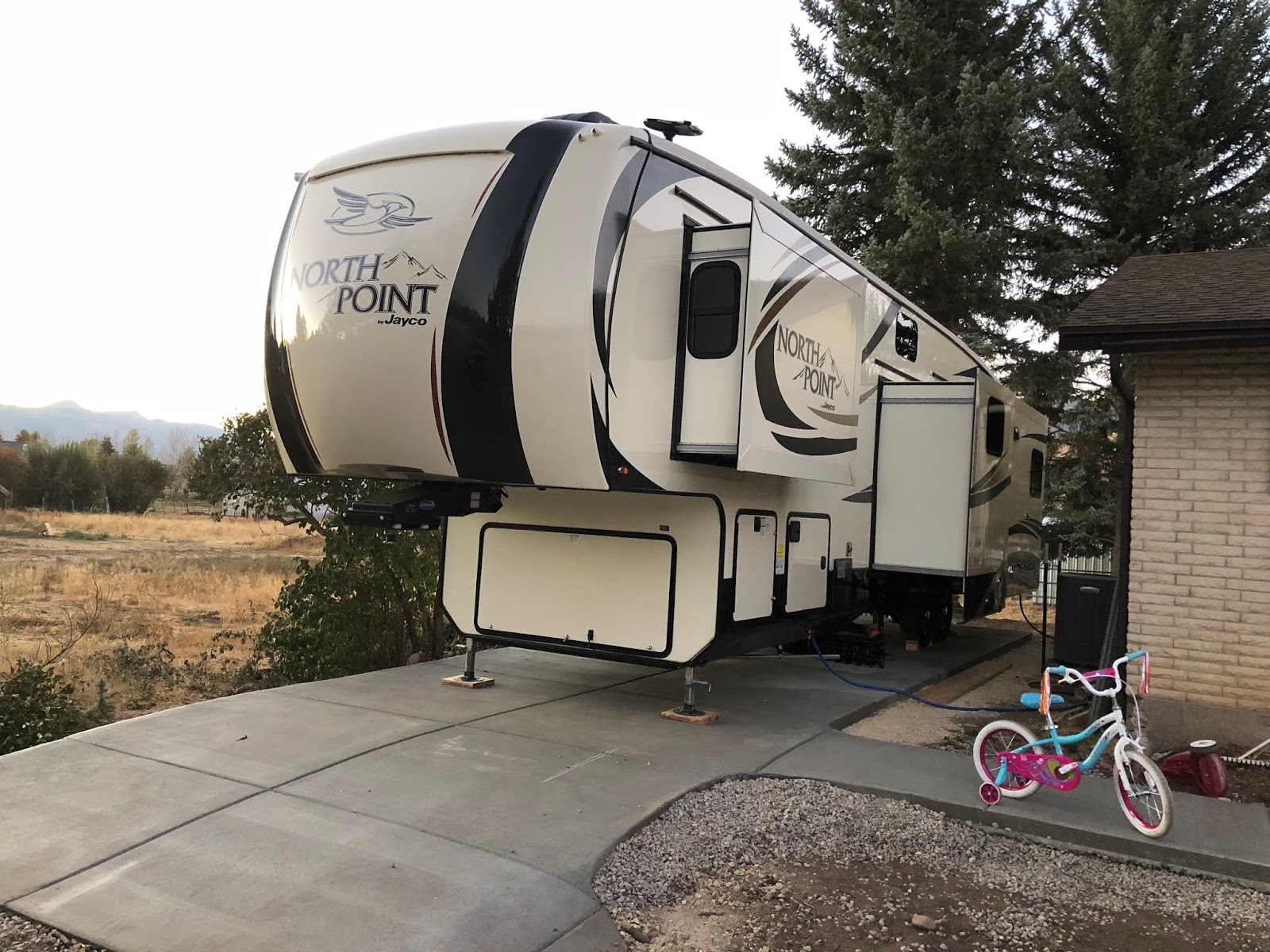
Meanwhile, this month we had a concrete RV pad poured next to my daughter and son-in-law's house in Huntsville. I also had a septic dump installed, as well as a 50 amp power outlet. I installed a new freeze-protected hose bib for water. Earlier this month I bought a used 2017 Jayco North Point 377 fifth wheel (used twice in 15 months by the prior owners; otherwise stored indoors). I paid $30,000 less than they paid when they bought it new, so I was pretty happy with the deal. Yesterday I picked it up, parked it on the pad, and hooked it up. Much as I love my grandkids, it will be nice to have my own place to live.
My new home

Wednesday, August 22, 2018

Infusion 51: reports of my CR are premature


Last week Garrett and I flew from SLC to IAD, and spent a couple of days prepping him for delivery to Carnegie Mellon. He admitted that he was a bit more nervous about starting college than he was starting a 2 year mission for the church, because his schedule was more set on his mission. I told him that, of all of his siblings, he was the best prepared and most mature to attend college. I helped him move into his dorm room, gave him a hug, and said I’d see him at graduation. Dad! he said. I replied that I hoped that I would, but who knows what will happen in 4 years. But I’d also see him at the parent weekend in October, maybe for Thanksgiving, and certainly for Winter Break. And he was launched.

Om Tuesday, August 21, went in for blood work. The first tech managed to blow two veins before I asked for another tech, who had no problems with the draw. My labs are utterly unremarkable. My ALT and AST levels, which had been creeping up earlier in the year, are back in the normal range, indicating my liver is happier.  I met with Dr. Ferreira, my Kaiser oncologist. She acknowledged that she was somewhat surprised by the radiologist’s conclusion from last month’s PET scan that there was no evidence of disease, and I’d had a complete response. She took a hard look at the scan images and detected a bit of metastatic uptake in the area of my primary tumor in my neck. She showed them to me, and she’s right – there is a bit of uptake – not a lot, but not nothing. So it looks like the report of a CR was premature. But I’m not complaining. It’s still a great result! More than 90% reduction in tumor size is wonderful. It just suggests that I should keep on taking Opdivo for a while, and continue getting scans. We scheduled another visit and a CT for October, after the parent’s weekend at Carnegie Mellon.

After visiting with Dr. Ferreira, I drove up to Baltimore for my final meeting at Johns Hopkins with Dr. Hahn under the aegis of the clinical trial. Brad Witt, the clinical trial nurse, said that I was the last Hopkins patient in the original Opdivo clinical trial who was still considered to be within the trial. The 40 or so other genitourinary mets patients at Hopkins in the trial had long since stopped taking the drug. Those still living were still being followed, but were no longer considered to be part of the trial. I’d started the trial in early 2015, taken the drug for nearly 2 years, then took a break for about 18 months before resuming treatment. Hopkins will still continue to email or call every 12 weeks or so to make sure I’m not yet on the cart (not quite dead yet), but my obligations to visit Hopkins as part of that clinical trial is done. I’m profoundly grateful to have been part of that clinical trial; to Dr. Andrea Apolo at NIH for helping to arrange for my participation; for the clinicians at Hopkins who provided my care; and to Bristol Myers Squibb for developing Opdivo and providing the drug at no cost. Opdivo has saved my life not once, but twice. It may not work for everyone, but it’s continues to work for me.

Dr. Hahn and I spoke about one of his former fellows, Dr. Ben Maughan, who now is with Huntsman Cancer Center in Utah. Dr. Hahn thinks that, once I officially relocate my care to Utah, my transitioning to Dr. Maughan’s care is a great idea. I’ve started vetting the Medicaid Advantage plan associated with the Huntsman Cancer Center.  SO far the reps have no idea whether Opdivo would be a covered drug. That’s potentially a very expensive question (up to $50,000 per year, perhaps). I won’t change my care from Kaiser until I’ve got that issue worked out. I shook Dr. Hahn’s hand and thanked him for saving my life.  Our paths are likely to continue to again at various BCAN or NIH/NCI initiatives.

Today (Wednesday), I went back to Kaiser for Opdivo infusion #51. Utterly routine. So far the side effects of the 4 week infusions of nivolumab has been no different from the two week infusions – an occasional rash here and there, and a bit looser bowels. Nothing to worry about. I appreciate having to come in only once every 4 weeks. I’m flying back to Utah this evening. Chelsea is due to delivery any day now, and I’m glad to help with the other kiddies. And it will be good to see Jennifer.

I’ve been investigating my health care options in Utah. Since the federal government considers me to be as totally and permanently disabled due to my metastatic bladder cancer, I’ve been Medicare-eligible since I was 50 years old. I started on Medicare in January 2016, after my formal retirement from my law firm left me without work-sponsored health insurance. Beginning in January 2016, I’ve been with Kaiser Permanente’s Medicare Advantage plan. I’ve become spoiled, since it’s been the best health care I’ve received in my adult life. I was already on my clinical trial through Hopkins when I joined Kaiser, and Kaiser not only agreed to continue supporting my care through Hopkins, but the plan enrolled me into their additional benefits through the Kaiser Family Foundation, which meant that I have not had to have any further expenses such as deductibles or copays. I have not had to worry about the cost of Opdivo, or my scans, or anything else.

In Utah, however, Medicare plans are not as generous. I’ve learned that because Opdivo is given by infusion, it is classified as a Medicare Part B drug that is subject to a 20% copay up to the annual plan deductible (around $5000). I’m told that non of the Utah Medicare Advantage plans cover the Part B copay. I don’t yet know how much the plans charge Medicare for my monthly 480mg dose of Opdivo, so I don’t know the amount of my copay. I’m doing further investigation, so I know my costs up front. Until I get that worked out here, I’ll fly back out here for my treatments. I’ve already bought my tickets for September and October.


Friday, July 27, 2018

Infusion 50 and a PET scan, and a complete response

It's hard to believe just 4 weeks has passed since my last infusion. Since then, Chelsea flew to DC, joined Jennifer and I as we attended a farewell reception at a friends house, then then next day turned around and flew back to SLC with Jennifer and me. We got Jennifer settled into her new specialized memory care assisted living facility, then I went with Chelsea to her house in Huntsville. The next few days were a blur of visiting Jennifer and taking her to her medical appointments, spending time with Chelsea, Josh, and the grandchildren, and readjusting to the slower rhythms of small-town life.

On July 9, Garrett completed his two-year mission for the Church of Jesus Christ of Latter-day Saints. Jennifer and I met him at the mission home in Salt Lake City, and were able to attend the departing missionary fireside. Garrett sang "Be Still My Soul" acapella, then bore his testimony. It was a moving experience. When he finished, I moved and let Garrett take my seat next to his mother.  Jennifer laid her head on his shoulder and wept tears of joy.

The next day, Spencer and Kirsten joined us in Utah. It was the first time our complete family had been together since March 2016. I had wondered whether I would live to see that day. We went boating, played games, and ate together, soaking up each other's presence. We met with a social worker who guided the kids through a discussion regarding their mom's cognitive decline, and suggestions on sorting through their emotions. We also had a family council where we discussed the estate planning steps that Jennifer and I had taken, and made some decisions regarding family finances.

After nearly a week of family time, Kirsten and Spencer drove to Denver, where Spencer embarked on hiking the Colorado Trail from Denver to Durango (blog link here). It's "only" 487 miles, so unlike his thru-hiking the Appalachian Trail last year, he'll knock this out in a month or so. I keep telling him there's medication that can help cure his hiking illness, but he declines my sage advice.  The best medicine, I've found, is sold at Krispy Kreme.

On July 20, Garrett and I flew back to DC. On Sunday, July 22, Garrett gave his missionary homecoming report to his home congregation in Great Falls. He left a boy and came home a man. I also spoke.

Yesterday, I went to Kaiser and had infusion #50. The only side effects I've noticed so far from my increased dosage of nivolumab is some scalp itching and perhaps a tendency for my gums to bleed slightly after brushing my teeth. No big deal. I'll continue to monitor any side effects.

Last night I battled traffic for nearly two hours to get to Kaiser's Capitol Hill location for a PET scan. That's a drive that takes perhaps 30 minutes when it's not rush hour. I am not going to miss DC traffic. My Kaiser oncologist agreed to my request for the test a couple of days ago, so I was added to the end of the day for the end of the day. The nurse just called and said the scan showed no evidence of metastatic disease -- a complete response! Woo hoo! Dr. Ferrera recommends keep going with Opdivo for now. Based upon this news, I'm more likely to  eventually shift my ongoing care to the Huntsman Center in Salt Lake.

Southwest cancelled our flight to SLC this afternoon, due to the heavy weather that is forecast to hit the region later today. So we're no scheduled to return to Utah on Saturday. We'll stay for a couple of weeks, then return to DC on August 14. I'll deliver Garrett to college on August 18, then have another infusion at Kaiser  the following week. I'll also be meeting with both Dr. Hahn at Hopkins and Dr. Ferrera at Kaiser, and likely will confirm my decision to transfer my care to Utah. For now, however, I'm simply relieved to be back in remission.

Sunday, July 22, 2018

Church talk: We all are immigrants

Following are my prepared comments for a talk I gave in the sacrament meeting of the Great Falls Ward of the McLean Stake of the Church of Jesus Christ of Latter-day Saints on July 22, 2018:

Tuesday, July 24, is Pioneer Day in Utah. I have a confession to make. I never felt much affinity for stories of the Mormon pioneers, crossing the plains in 1847. I had no forebears who were pioneer stock, and felt kind of left out by those stories. So I’m not going to talk about the pioneers and the Days of ‘47. 

Actually, I am going to talk about the Days of ‘47. 

In the fall of 1947, Brother and Sister Mondfrans, a senior Mormon missionary couple from Ogden Utah, knocked on the door of a residence in Hilversum, Holland. The door was opened by my grandma. At the time, she was 47 years old. She was a mother of 6, with her the youngest just a year old. The Mondfrans’s stayed at that home for 6 hours, taking turns holding the baby and teaching the gospel, first to my grandmother (Oma), then to her children as they arrived home from school or work, and then to my grandpa, or Opa. 

My mom was 13 years old when she first met the Mondfrans's in 1947. The women of family studied the gospel of Jesus Christ for months. The Mondfrans’s returned to Ogden a few months later, never having baptized them or anyone else. They thought that their mission was a failure. 


In February 1948, Oma, my mother, and her older sister were baptized in a swimming pool in Utrecht and became members of the Church of Jesus Christ of Latter-day Saints. Oma then devoted her relentless energy to teaching the gospel to the rest of her family, and within a year, they all had joined the Mormon church, including the spouses of her older children, and Opa. They helped establish a branch in Hilversum, with Opa representing the LDS church in locating, negotiating, and purchasing a building for use as the chapel.
During her studies, Oma had learned about the promise of eternal marriage, with the promise that families could be together forever, when marriages were solemnized in the temple by those having proper power and authority from God. She became passionate about wanting her family to be sealed in the temple. There were no temples were in Europe at that time. The closest temple to Holland was in Salt Lake City, over 7000 miles away.
Oma began to discuss with Opa her idea of the family going to Salt Lake City. My grandfather thought it was a crazy idea. They did not have passports. They did not have visas to the United States. No one in the family spoke English. They could not afford round trip tickets. It simply was out of the question.
Oma agreed that they could not afford round trip tickets. So she said that it would have to be a one-way journey. The only way for her family to be sealed in the temple was to sell everything, leave their home country, and emigrate to America.
Opa said no. He loved living in Holland. He had no desire to start all over in a foreign country. Opa had worked at the Post Office for 33 years. He had a pension coming. He explained to Oma that the Dutch pension system would not remit payments to foreign countries. The pension money had to be collected in Holland, from the Bank of Holland. If Opa moved to the US, he would be unable to collect his pension.
All of my grandfather’s concerns were perfectly understandable. They were rational, and reasonable. Traveling to the US to go to the temple was simply not possible, he said.
My grandmother answered: "If the Lord wants us to go, the way will be opened to us."
Opa just sighed. He knew how strong-minded his wife was. Once she got a certain idea in her head there was very little chance she would change her mind. So he said that, if she could get the visas, raise $6000 (more than $60,000 today), and figure out how he could collect his pension in America, he would go. Then he put it out of his mind, because he knew it was not going to happen.
At this time (in 1949), US immigration law allotted only 3000 immigrant visas each year to Dutch citizens. Each visa recipient had to have a sponsor, and prove that they had sufficient funds to get established in the US. In post-WWII Europe, there was strong demand for visas to America. Eventually, Oma persuaded Opa to apply for 4 visas: the two of them and their two youngest children.
Meanwhile, Oma had to figure out where to get the money. She got the idea of finding someone who would loan them $6000, then be repaid from Opa’s pension payments in Holland. Opa sarcastically said that she should find an LDS family in Utah who had a bunch of pension money being held for them in Holland, and who would agree to let her and her family access those funds, and who would agree to let them be repaid from Opa’s future pension payments.
“That is the answer!” Oma answered enthusiastically, “We will find a person in that situation.”
“And how do you plan to find such a person?” Opa asked.
“We’ll pray about it and if the Lord wants us to go to the temple, He will lead some one to us.” Opa rolled his eyes and bit his tongue.
In April 1951, the family was awarded 4 visas to emigrate to the US. They had six months to find a sponsor, and find $6000. If they did not succeed within six months, the visas would expire.
Each day Opa would come home from work and ask, “Any news?” Mother would shake her head and say “It is up to the Lord.” Opa would smile and say nothing more. He did not want to move to America.
Several months went by. Each day, Oma would petition the Lord for a way to be opened for them to go to the temple. Those prayers were joined by my mother who was turning 17 in the summer of 1951. She had completed her studies in Dutch school system, and was the only family member who spoke any English. She very much wanted to move to America. But they had no money, and no sponsor.
In September 1951, five months had passed since the visas were issued. They would expire in 4 weeks. Nothing.
Three more weeks went by. Opa knew that they were not moving to America.
The first week of October arrived. It was the last week before the visas would expire. On Monday, Opa cheerfully asked, “Any money yet?” “No, but the week is nor over yet,” Oma would answer.
On Tuesday he asked the same question. “Not yet”, she answered, “but I did check that there is a ship leaving for the US on Saturday. It’s a freighter, and it still has room for the 4 of us.” My grandfather gave his wife an incredulous look, and bit his tongue.
On Wednesday Opa came home and asked the same question.
“Yes”, Oma answered, “Sister Mann’s daughter came over today. As you know, her parents emigrated to America two years ago. She just received a letter from her mother telling her that we can borrow her husband’s pension money. They have more than $6000 available and we can use whatever we need. They also will sponsor us. Tomorrow, you and Tina will have to go to Amsterdam to buy the tickets on the ship that I told you about. We will be leaving Holland three days. The Lord has just been testing us to see if we would have enough faith to wait this long.”
Brothers and sisters, do you believe in miracles?
My grandmother had already packed her bag. No one else in the family had done anything to prepare. Now they had three days to prepare to leave their home country and move to America. All because of my grandmother’s desire to be sealed in the temple. That desire, that hope, that faith, to be sealed to her husband and children for time and all eternity, was a moving principle.
Brothers and sisters, do you share that same yearning to go to the temple?
We are taught that faith can move mountains. I never have seen a mountain move, but I know that the faith of my grandmother brought her and her family into the church. It brought them to the docks of Antrwep on Saturday, October 9, 1951, to board the freighter Edam to New York. It brought them a 5 day journey on a Greyhound bus from NYC to SLC. It brought them to a fully furnished two bedroom apartment in SLC, prepared my members of their new ward. There even was a pot of soup bubbling on the stove. And it brought them to the temple, the house of the Lord.
My Oma’s faith was as bright as the sun, and powerful as a laser. Her faith was the moving force that has changed the course of lives of thousands of people. Her faith caused the spirit of the Lord to influence the actions of others: the Mann’s, who agreed to sponsor them, and loan them the money. The members of their new ward in Salt Lake, who put everything in place for these weary travelers. Those members who were willing to minister to people they didn’t even know, simply because they were asked.
When we are in the service of our fellow beings, we are in the service of the Lord.
My grandparents have hundreds of descendants. Dozens – including their great grandson, Garrett – have served full-time missions. Those missionaries have been instrumental in baptizing hundreds, if not thousands, of others. Among those converts, many have served missions. Many thousands of lives have been changed by the faith of my Oma, a 20th century pioneer.
My mother is an immigrant to America, and became a naturalized citizen. I am in the first generation of that lineage to be born American. I am profoundly grateful to be a citizen of this country. 

We are taught that “it is not common that the voice of the people desire[] anything contrary to that which is right; but it is common for the lesser part of the people to desire that which is not right” (Mosiah 29:26). I fear that we living in uncommon times. We have an obligation individually and collectively, to oppose tyranny, oppression and unrighteous dominion, to speak and pray for peace, and to ensure the blessings of liberty to ourselves and our posterity in this land, a nation born of immigrants and refugees.
All of us are immigrants. “As members of the Church, we are admitted into the house of Israel. We become brothers and sisters, equal heirs to the same spiritual lineage. God promised Abraham that “as many as receive this Gospel shall be called after [his] name, and shall be accounted [his] seed, and shall rise up and bless [him], as their father.” A promise has been made to everyone who becomes a member of the Church: “Now therefore ye are no more strangers and foreigners, but fellow citizens with the saints, and of the household of God.” (“Ye Are No More Strangers”, by Bishop Gerald Causse, First Counselor in thePresiding Bishopric, October 2013 General Conference.)
            Being strangers in a new country, or new congregation, can be intimidating. A desire for the old country, or our old ways, sometimes can be overpowering. A fear of change, or of stretching, can inhibit growth.

In September 2000, when my family and I moved to Great Falls, I was a stranger to this ward. The second week of church, as I was trying to enforce reverence with my two year old (who now is sitting behind me as a returned missionary), I heard the Bishop unexpectedly speak my name, along with the words “young men’s presidency” and “scoutmaster”. I turned to Jennifer and asked, “Did I just get called to something?” She half nodded in surprise, and we both gave Bishop Croft the stink eye. I half stood, uncertain of what was going on, and tentatively sustained myself to an unknown calling. Yet with that calling, and subsequent callings, I have grown.

A few weeks ago, a grown man came up to me and fondly recalled how, 10-15 years ago, I had taught him in Sunday School as a teen. He said that he didn’t recall much of the substance of my lessons, but remembered how, at the end of each lesson, if everyone behaved, I would teach the class a "new truth" from the scriptures. Like how Nahum prophesied street racing (Nahum 2:4). How Jeremiah said we should not have Christmas trees (Jeremiah 10:1-4). Or how Jesus instructed his disciples to not watch television (Matt 17:9 “tell the vision to no man”). Or, most controversially, how there are no women in heaven (Rev.8:1). (Remember, these are meant to be facetious.)

            As should be clear from this talk, I can’t claim to have the same faith as my grandmother. I think I’m closer to Opa, not seriously thinking that the gospel lightning will strike me. Yet as I look back on my life, I can see the traces of Oma’s influence in my life. To stay the course. To keep going. To not question the things that the Lord sees fit to inflict upon me (see Mosiah 3:19).

            And the Lord has seen fit to inflict much upon me. The challenge of balancing my time. Seeing my children at times making unwise decisions. I have learned to let go of expectations and grant them their agency. I have walked through the valley of the shadow of death with my ongoing journey with metastatic cancer. And I have been rendered – in every meaning of that elemental word – by my wife’s descent into early onset dementia. It is wrenching to lose a loved one while she is still living. I hope that in being weighed and measured, I have not been found wanting (see Daniel 5:27). I hope to have courage to endure to the end (see D&C 14:7).

            And yet, I can find joy in every day. I have been sustained by the love of my family. Garrett, you do not know how your weekly letters gave me strength to carry on. Your selfless service nourished my soul during a spiritual famine. They were my weekly manna. Thank you.

            I have been sustained by the love and support of my friends during these difficult times. Thank you. And to all the members of this congregation, who have supported and sustained me during these 18 years, thank you. May the grace of the Lord Jesus Christ, and the love of God, and the communion of the Holy Ghost, be with you all. (2 Cor. 13:14)
Friday, June 29, 2018

Infusion 49: now on 4 week schedule

Earlier this year Bristol-Myers Squibb obtained FDA approval to have nivolumab administered every four weeks, instead of every two weeks. After Dr. Hahn told me that he was dosing virtually all of his patients on a 4 week schedule, I asked my Kaiser doctor whether I could shift to that schedule. She agreed, so today I have my first 4 week dose (a Q4W (480 mg) flat dose). An added benefit is that this Opdivo dose can be administered in 30 minutes instead of an hour, making my infusions not only less frequent but faster. The only downside is that my infusion nap isn't as long. 

Four week intervals also means that scheduling my infusions becomes much simpler, especially because I'm going back and forth between DC and Utah. I fly to Utah on July 2, and will come back with Garrett on July 22. His homecoming will be on July 22 (Scott's Run building at 1 pm, y'all come). I'll have infusion #50 later that week. Then we'll go back to Utah for three more weeks. The week of August 12, we'll return to DC. On Saturday, August 18, I'll drive Garrett up to Pittsburgh so he can move into his dorm at Carnegie Mellon. My baby's going to college! Then I'll have infusion #51 the following week, along with my very last follow-up with Johns Hopkins. Whether I transfer my care to Utah may depend on whether my mets are responding to this treatment. If not, I'll likely pursue clinical trials in the DC area. But I'll worry about that later. I'm simply grateful for each day.

A four-week schedule also means that my blog posts likely will be less frequent, as I try to post when something happens related to my cancer. If you're looking for something else to read, I recommend the following:

Circe by Madeline Miller
Educated by Tara Westover
The Broken Earth trilogy by NK Jamison
Book 1: The Fifth Season
Book 2: The Obelisk Gate
Book 3: The Stone Sky
Station Eleven, by Emily St. John Mandel
American War, by El Akkad
The Handmaid’s Tale, by Margaret Atwood
The Sparrow, by  Mary Doria Russell
Children of God, also bt MD Russell
Fourth of July Creek, by Smith Henderson
The Dispossessed, by Ursila Le Guiun

Tuesday, June 19, 2018

Infusion 48; CT scan showns stable disease


On Thursday, June 14, I had my labs done in advance of my next Opdivo infusion. My labs were unexceptional, with the exception of continued increases in my liver enzymes (alanine aminotransferase, or ALT, 84 U/L, and aspartate aminotransferase, or AST, 56 U/L). Both have been creeping upward as my new tumor has grown. The levels are not so high as to cause immediate concern, but it’s something to watch, like an inexorably rising river during high rains. My prior CT scans have shown small nodules in my liver, nothing large enough to be definitive, but something to be aware of. If I had to bet, I’d guess that my liver will be the first organ that will have metastatic activity. I’ll cross that bridge when I come to it.

On Friday (June 15) I had nivolumab infusion #48 at the Kaiser Tysons Corner office. It was the third since I’ve resumed my treatments with Opdivo, and was so routine that I fell asleep. The nurse reported that I was snoring. Clearly I’m not drinking enough Diet Coke.

On Monday (June 18) I had another CT scan. There were 20 people in the waiting room and I resigned myself for a long wait, but the advantage of being a frequent scanner is priority boarding. I was quickly called in by the tech who remembered me due to my generous tips and was rewarded with only one blown vein. Maybe 15% of nothing is not enough? As usual, after the scan I was told to drink lots of fluids to flush out the barium and iodine. As usual, I went to McDonalds for two sausage and egg McMuffins and four liters of Diet Coke. And as usual, Kaiser had the CD of my scans ready after my visit to the Golden Arches.

Today (June 19) I received the results of yesterday’s scans. The headline is that the primary tumor in my neck has not grown in size. Stable disease is better than active growth. The scan actually measured the tumor to be slightly smaller, but that is most likely due to how the tumor was sliced by the scanner. Here’s the relevant text from the neck scan:

The previous enlarged left level 3/4 junction lymph node somewhat more difficult to see because of beam hardening artifact from adjacent contrast bolus but appears to measure about 1.4 x 1 cm which is borderline enlarged, though smaller than the previous size of 1.7 x 1.4 cm. Otherwise no enlarged or pathologic-appearing lymph nodes are seen throughout the neck.”

For my chest, abdomen, and pelvis there was “no significant lymphadenopathy or evidence of metastatic disease.” So yay for no tumor growth.

Later in the day, I went to Johns Hopkins for my last visit in connection with my participation in the Bristol-Myers Squibb-sponsored clinical trial that led to the FDA approval of Opdivo for metastatic bladder cancer. Because of the FDA’s approval last year, I can get nivolumab from any oncologist without my being in a clinical trial. I expressed my deep appreciation to Dr. Noah Hahn, and to senior clinical trial nurse Brad Wilt, and to the entire Hopkins staff, for their profession, compassionate, and persistent work at prolonging my life.

I also discussed with Dr. Hahn his recommendations going forward. He said that I should probably continue with nivolumab until either all my tumors were gone, or they were actively growing. In the even that my tumors continue to grow, Dr. Hahn said that there were lots of new therapies being tested on patients who had disease progression following immunotherapy. He mentioned a number of them – some of which I’ve previously blogged about – and invited me to reach out to him to discuss if and when that time came. He also encouraged me to keep up with my blog, saying how many of his patients had mentioned to him how they were readers of my blog. More than a few had sought him out based upon my good experiences with him and Hopkins.  

Dr. Hahn knew that I was planning on moving to Utah at some point, and said that one of his fellows,Dr. Ben Maughan, now practices with the HuntsmanCancer Center in Utah. Dr. Maughan likely will become my new oncologist when I eventually transfer my care out there. 

Life, meanwhile, has taken an unexpected turn with my wife’s unexpected diagnosis of early onset dementia. Jennifer’s cognitive decline became pronounced last October, and for the past nine months we have struggled to determine the problem. Four hospitals, 11 doctors, and 13 different drug regimens later, she continues to suffer from daily confusion, uncertainty, disorientation, and wandering. This disease is horrible for anyone, but seems especially cruel to strike my faithful wife at age 54. After her last hospitalization, the doctors recommended that she be transferred to an assisted living facility that specializes in memory care. She’s currently residing at a memory care center in Northern Virginia. After consultations with doctors and family, we’ve made the decision to relocate Jennifer to another memory care facility in Northern Utah on July 2. There she will be closer to our oldest daughter, a practicing physician, and her extended family.

This decision was informed by the very real risk that my disease will progress and that I won’t be around that much longer to be Jennifer’s primary caregiver. There is no published data to inform me of what happens to people with metastatic bladder cancer who have had a partial or complete response to nivolumab. Looking at data for mets BC patients who have had other types of immunotherapy, an article published earlier this year examined long-term outcomes for people with metastatic urothelial cancer who were treated with atezolizumab.  A close reading of the data and review of the charts suggest that, once there is a recurrence, most patients die within a year.

A major limitation of this article is that the data set closed in December 2016, before many of the most recent combination drug therapies were even being tested. Also, the data set is small, the age of the patients skews much older than me, and they have more co-morbidities than do I. Plus, my recent scan tells me that, for now I have stable disease. But still. I am realistic about my poor prognosis. I have no use for rose-colored glasses, especially when planning for the care of my wife after I am dead.

We’ll get Jennifer settled into the Utah memory care facility in early July. Garrett will complete his two year mission for our church on July 10. Spencer and Kirsten will join us in Utah for a few days, and we’ll have a Brothers family reunion – the first time all of us will be together since March of 2016. Garrett will have only a few weeks to transition into normal life before he matriculates at Carnegie Mellon University in Pittsburgh, so at some point he and I will fly back to DC to prepare for school.

I’m scheduled for infusions through Kaiser on June 29, July 16, and July 30. I’ll ask to have a PET scan in late July or early August, which may give better insight into whether the nivolumab is working. Notwithstanding the results of yesterday’s scan, I have not been holding out hope that Opdivo will work as well this time, for three reasons. First, Dr. Hahn previously told me that, in theory, the nivolumab should have taught my immune system to kill every cell that had a PD-L1 enzyme, so any new tumor growth is probably another mutation of my mutation-rich metastatic bladder cancer. Second, my original mets lit up on CT scans a lot better than this tumor, leading me to wonder if it’s a different type of mutation. Third, projecting hope takes a lot of energy, and my energy has been directed elsewhere lately. Given that I have no control over my cancer, I have found that I expend far less emotional energy by accepting the facts of my prognosis as it is, rather than setting myself up for a dissonance between what may be false expectations and reality.  Plus, I’d rather be pleasantly surprised than bitterly disappointed.

If and when I find out that nivolumab isn’t working, I’ll look at my next options. That will be Plan F. I’ll reach out to Dr. Hahn and Dr. Apolo, among others. For some strange reason, there are more clinical trials available in the DC area than in Utah. Go figure. So maybe I’ll stay in DC longer, or commute back and forth between Utah and DC as needed. I knew there was a reason we hadn’t sold our house yet.

If, however, I learn in August that the Opdivo is causing my tumors to shrink, then I’ll likely relocate to Utah after I deliver Garrett to Carnegie Mellon. I’ll rent a place somewhere between Jennifer’s assisted living location and my grandchildren and look for goodness and joy every day.


Thursday, May 31, 2018

Infusion #47

Today's infusion was utterly routine. I'm glad that I'm getting my Opdivo at the local Kaiser Permanente facility. It's close by, and I'm in and out in the time that it took me to drive to Baltimore. It's the newest and nicest of any of the infusion centers I've been to so far (GW, NIH, Hopkins, and now KP Tysons). Plus the nurses bring me cold Diet Cokes so I don't even need to put down my recliner.

It looks likely that I'll be moving to Utah by the end of the summer. Jennifer has been suffering from some serious health issues. In light of my precarious health status, I thought it prudent that we get her reestablished closer to her family as well as our doctor daughter. So I've been looking into the availability of continuing by treatments at the Huntsman Cancer Center at the University of Utah. It appears that I should be able to do so. My greater concern is the availability of clinical trials in Utah if the nivolumab does not work. There are a lot more options in the DC area. But I'll cross that bridge when I come to it.