Our flight to Johannesburg on SA 208 left Dulles International Airport at 5:20 pm, and was scheduled it land at JNB at 5:15 pm the next day. I had booked these tickets by accumulating miles on United Airlines from old business travel, plus opening a couple of credit cards and piling up the award points. One way economy seats were 40,000 miles each; the cost to purchase the same seats was $2800 each. There were cheaper flights available, but all went through Europe and many were back to back redeyes.
I've flown from DC to Korea, as well as DC to Tokyo, several times, and this flight to JNB was one of the longest plane rides I've experienced: 16.5 hours on the air, plus an hour on the ground in Dakar, Senegal for refueling and a crew change, with through passengers not permitted to get off the plane. Jennifer, Kirsten, Garrett, and I shared a center row; Spencer had an aisle two rows ahead of us. There in no such thing as sleeping comfortably in an economy airline seat, although Kirsten and I amused ourselves watching Garrett's head nod, bob, sag, and weave. In Dakar, members of the Senegal men's basketball team boarded, and the 7'2" center sat behind me. I then realized my lack of legroom was not so bad, although his knees unavoidably massaged my back.
While on the flight, Spencer had left his glasses hanging out of the seat pocket. At some point, woman sitting next to him knocked them out and snapped off the frame at the temple. Spencer discovered his broken glasses under her chair, and she sheepishly admitted to breaking them. She made no offer to accept financial responsibility, and what could Spencer do about it? Unfortunately, they were his only pair, but fortunately, he also had brought his contacts.
Monday, July 27
Upon arrival in Johannesburg at 5:15 pm, everyone was required to fill out a form regarding potential Ebola exposure. The forms were collected with barely a glance by harried officials, so it was not a particularly effective method of self-reporting. Passport control required us to provide an original birth certificate for Garrett - a new law designed to prevent child trafficking - and fortunately we had come prepared. We saw several children being dragged away from screaming parents who were not aware of the new law. (No we didn't - but I wondered what happened to tourists that did not bring their kid's birth certificates. Were they really denied entry and made to fly back to their home country?)
We collected our bags, and emerging into the terminal we saw a Sunglass Hut kiosk. Maybe they could repair Spencer's glasses! No such luck, but the woman said that there was a nearby mall with several optical shops. We also picked up a porter who was happy to show us where to meet the hotel shuttle (tip, please), which reminded me that I needed to find an ATM. The South African Rand currently is very weak compared to the dollar, trading at 12.5:1, which makes most things a relative bargain.
We rolled into the Protea Hotel O.R. Tamboro at about 7 pm, and we were tired. I had three rooms via Marriott Reward points, so we dropped our bags, went to the buffet dinner, then fell into bed.
Tuesday, July 28
Spencer was the only one who got up early for a workout. The rest of us slugged our way down for breakfast, then packed up and checked out. Bearded Heron Safaris had arranged for a driver with a minibus to meet us at 9 am and drive us to Kruger National Park. We persuaded the driver to first stop at the nearby mall to see if Spencer's glasses could be repaired. The optician said that the frames were unrepairable, but that the lenses could be re-sized and mounted into a new pair for frames. That would take 3 days, however. I figured that we'd be back in Johannesburg next Monday for our flight to Zambia, so we agreed. The frames and resizing cost only $85!
We made our way east across the veld and through the hilly Mpalangna region, entering Kruger National Park (KNP or, as locals call it, "The Kruger") at Malelane Gate. We got out of the van as the driver obtained our permit, and saw a troop of vervent monkeys in a tree, under which a herd of impala were grazing. Our first photo opportunity! Smiles all around. We passed a couple of baboon, then stopped to watch a mother elephant scratching its back, rear, and ears on a tree, closely observed by a female calf. Cool stuff.
We arrived in Berg-en-Dal rest camp, where our van driver handed us off to Neil Heron, owner and sole guide for Bearded Heron Safaris. Our driver turned around to drive back to Joburg (I hope my tip of R100 was appropriate), and we met our host. Neil Heron was raised in the bush, went to university in Great Britain, returned to South Africa to work for and eventually run the South African division of Penguin Publishing, before deciding to start his safari company in 1993. His compatriot and cook, Alister, was also an ink stained wretch at Penguin before coming aboard the safari gig. Neil's wife, Tina, does all the booking and logistics, and Neil spends 220 days of the year in The Kruger. Neil has kept Beaded Heron small so he can personally guide all of his clients. We are happy to be his only concern for the next six days.

After a brief snack of fruit cocktail, we headed out on our first game drive. It was only a 4 km drive on a dirt road immediately outside the gate of the camp, but what variety! We saw 5 giraffe, dozens of impala, several elephants, a huge kudu buck who blended in perfectly with the bush, and later the rest of the kudu clan, a mother and calf white rhino near a watering hole, and most impressively, the dominant rhino marking his territory in the midden circle, then walking across the road between our safari truck and the line of vehicles behind us. Wow! All the while, Neil was telling us about the activities of each of these creatures, and how they were interdependent upon each other.

Neil taught us about the birds in the Kruger, introducing us to the Grey Go Away bird (its real name, because of its distinctive call), and the dove with the call that sounded like it was saying "work harder." We saw plenty of lilac-breasted rollers, whose coloring looks like it was made by a five year old with a large box of crayons. Over the six days we were in the Kruger, Neil pointed out birds faster than I could forget them. This place is loaded with them - our guide book has 172 pages of birds and 44 pages of mammals, and I think that we've seen at least half of the bird species listed. It's too bad I'm not much of an ornithologist. We returned after our 90 minute game drive, thinking that if they all were going to be this cool, then this was going to be an amazing trip.
While we were enjoying our first exposure to the Kruger, Alister (Neil's long-suffering assistant) was preparing dinner. He had the charcoal going, and Neil tossed seven large steaks (400 g, or about 16 oz.) onto the grill. Neil explained that a "braai" - cooking meat over an outdoor fire - was a serious South African tradition. Each evening while in the Kruger, we were going to have a braai with different type of meat, prepared by our hosts. I remarked to my family that, when I was first exploring options for this trip, I had considered renting a car, self-driving through the park, and being responsible for all of our own cooking. I said that I was very glad that I did not follow through on that thought, even though it was far less expensive than having Neil as our guide and host.
Our lodgings in the Berg-En-Dal camp consisted of a brick stricture with a thatched roof, containing one large bedroom with three twin beds, a kitchen, and a bathroom with a delightfully hot shower. I joined the boys in one unit, and Jennifer and Kirsten had another one nearby. After our dinner and cups of hot chocolate, we turned in and by 9 pm were all asleep.
Wednesday, July 29
Wednesday morning we awoke at 5:20 am (Spencer had awoken at 3 am and went for a run, then stayed up) and met at a table on the porch of Neil and Alister's unit for hot chocolate and rusks - a type of crusty bread for dunking. The gates of the camp opened at 6 am, and we were off for our first morning game drive. The temperature was about 6 degrees C (low 40s F), and we were riding in an open-sided safari truck. It was a bit chilly, especially as we were driving around. We had packed and were wearing layers of clothes and gloves, and Neil provided each of us with a large woolen blanket that we sat on and wrapped around ourselves. As the day warmed and temperature rose to above 80 degrees, we stripped off layers and basked.
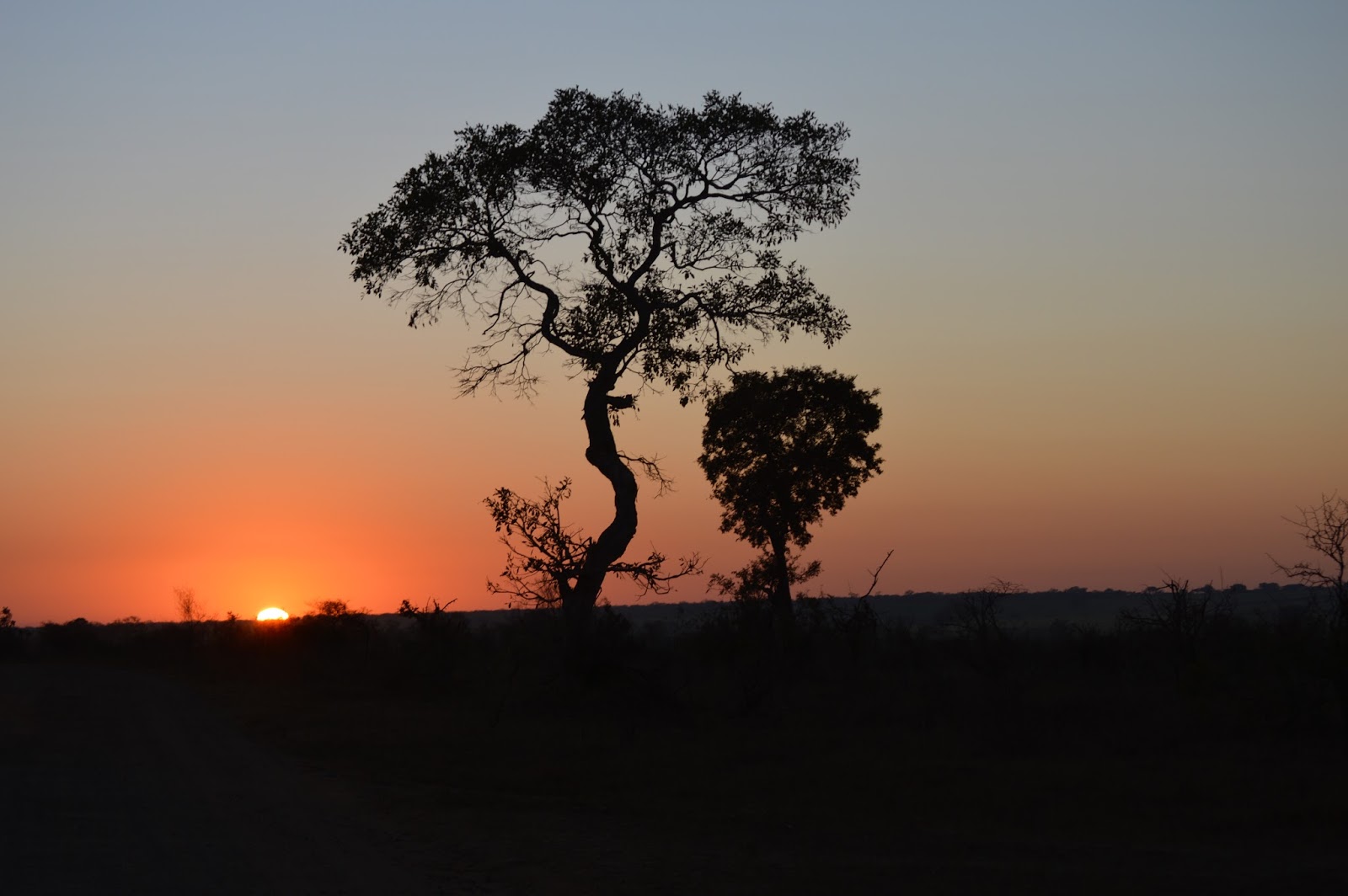
We drove east out of the camp and drove along the Crocodile River. As the sun rose, the kids started singing the opening song from Lion King. From time to time throughout our safari, one do the kids would start humming "The Circle of Life." I had various songs tumbling through my head from Paul Simon's Graceland, or Toto's Africa. It's hard to be on safari and not hear music in your head.
Soon after we turned off the oiled road (S114), we saw a mother rhino and calf about 20 feet off the road, closely followed by a large bull rhino. The bull was interested in making a social call to the mother, but she was having none of it. As he approached, she suddenly turned and crashed into him. He gave a roar of alarm and beat a hasty retreat. The mother and calf then crossed the road immediately in front of our car, while the bull sulked in a grove of trees.
We oscillated down a dirt road badly washboarded during the dry season. Neil occasionally would stop and look at tracks in the dust, explaining that he was looking for fresh footprints from lion and leopards. He explained how he could judge the age of a track by how crisp the edges were, and the age and frequently the sex of the cat by the size and shape of the print.

He also explained about tracking by examining the freshness and composition of the spoor - the feces - of various animals. As we drove along the Crocodile River, we could see that the south side of the river, just outside the park boundaries, were lined with enormous houses that Neil said were owned by celebrities and captains of industry, who rarely visited them. We were more focused on the beauty of nature rather than the hubris of man, however.
We did not see any cats on the morning drive, however. We did encounter a group of a half-dozen young adult male elephants that were making a ruckus while feeding, pushing down trees, spraying urine on bushes, tipping over buffalo, and engaging in behavior typical of sexually frustrated adolescent males. Neil said that it was very unusual to see such a group of males together - typically adult elephant males, once they reach sexual maturity, are kicked out of their family group and roam as solitary bulls until they form their own family. Sometimes they follow an older male around who acts as a mentor. But to have all young adult males roaming together was atypical. To me, their booming music and low-slung pants explained their affiliation, but Neil wasn't buying it.
We got back to camp at 11 am for a full English breakfast prepared by Alister - scrambled eggs, baked beans, sausage, bacon, potatoes, onions, tomatoes, juice, and hot chocolate. We took a brief rest, then were off again at 1:30 pm for another game drive. We saw many rhino, antelope, kudu, giraffe, and elephant, but the highlight was coming upon a group of five lions - actually four lionesses and one younger male. We parked about 15 feet away, and watched four of them were sleeping in the afternoon sun. A lionesses kept watch over them, occasionally circling the area, then laying down and grooming with the others.

The male eventually rolled over on its back, gave a tremendous stretch, then fell asleep in an utterly undignified pose, fore and hind legs splayed, and head upside down resting on one of the lionesses. Neil thought that these five were part of a larger pride of about 25 lions known to be in the area, and guessed that the rest of the lions were sleeping in a nearby dry riverbed. They probably had recently polished off a kill, and were sleeping it off. Neil told us that lions often sleep 18 of every 24 hours, but their prey never knew which 18 hours that might be, since they were usually hunting during the other 6 hours.

We returned to camp at 5:30 pm, and at 6 sat down to a nice braai of chicken and squash, along with rice and salad. The kids fell into bed by 8 pm, and Jennifer and I stayed up until 9:30 visiting with Neil and Alister. Our body clocks had mostly completed the six hour shift in time zones, but we were feeling it by the time we said good night. One thing about safaris - you get up before the sun rises, and don't stay up too long after it sets.
Thursday, July 30
This was the only morning with an optional dawn game drive. Kirsten, Jennifer and I were all in, but Spencer and Garrett elected to sleep in. The three of us were to meet Neil at 5:30 am for hot chocolate and rusks, but I mis-set my alarm for 6:20 am. At 5:40 am Kirsten knocked on the door to our hut and woke me out of a sound sleep. I hurriedly dressed and left the sleeping boys, apologizing to Neil and the girls for my being late. I must have been in deep REM, because it took more than an hour for me to feel fully awake. Perhaps for that reason, the game drive seemed less eventful than usual - we saw a few critters, but nothing that particularly stood out.

We returned to camp at 8:20 am to find breakfast waiting, and the boys still in bed. I roused them with the promise of bacon, and we polished off an amazing quantity of food. We returned to pack our bags, as we were moving camp today: Alister would take our bags and the Bearded Heron supply trailer to Skukuza camp and set up, while we would be out on a 6 hour game drive.
The highlight of today's drive was being surrounded by elephants. As we approached a single lane concrete roadway across the nearly dry Biyamiti river, we saw some elephants walking on the downriver side of the road. Neil stopped halfway across the causeway and we started taking photos. Soon another group of elephants approached us from the upriver side and came within 20 feet of the car. They paused at a well hole in the river bed that other elephants had dug, and proceeded to drink and spray themselves.

Neil slowly pulled the truck forward so we would not be so close to the elephants, only to see another group of elephants crossing in front of us as the road climbed out of the riverbed. He started to back up when another group of elephants starts crossing behind us. We had elephants all around us! In the group behind us was a mother with a very young calf - Neil estimated it was just a couple of months old - and the calf did not want to leave the small water hole. We watched as the mother stomped impatiently, then went back and pushed aside a couple of juveniles, and wrapped her trunk around her calf to pull it away. The calf bawled, slipped out of its mothers grasp, and went back to the watering hole. The mother stood nearby, rocking impatiently, spreading her ears wide in a threatening gesture, and bobbing her head. Neil thought that her anger was directed towards her calf, but she happened to be facing us. There was a chance that she was showing anger towards us. Neil said we should be ready to pull away quickly, but there were still elephants in front of us. Eventually, the calf came along, and the mother led her calf along, followed by two other juveniles - Neil said they likely were her other children - and they crossed behind us and went on their way.

During this time there were over 50 elephants that passed between 20 and 100 feet from our vehicle. I captured 20 minutes of this encounter on my iPhone, and perhaps will post it if I figure out how.
We rolled into Skukuza camp at 4 pm. Skukuza was one of the original Kruger camps, situated next to a rail line and on the Sabie river. It now is one of the largest camps in the park, with more than 200 round lodging units, called rondavels, each with three twin beds, a bathroom, and a kitchenette with a small fridge and hot plate, and of course a braai outside. As Neil and Alister set up camp, we walked by the river and like iron shavings adjacent to a magnet were pulled into the gift shop. Of course everything was gloriously overpriced, and of course we bought anyway.
 |
| At Skakuza Camp |
The adjacent restaurant had a sign promising free WiFi, so we pulled out our iPhones like empty canteens hoping to be filled, but alas! No signal. An employee said that maybe it would be working later, and I noticed a man seated nearby who was looking forlornly at his phone and sadly shook his head. I took that as an indication that we should not expect to connect with the world while in the Kruger. Jennifer would say that's a good thing.
Alister prepared another culinary masterpiece for dinner: Cape Malay Curry, a type of venison in a sweet sauce, served over rice. We finished the pot and licked it clean. We turned in to bed at 7:30, although I later ventured out and found the WiFi was working at 14.4 Mb dial-up speed. I looked at my emails, skimmed the headlines, and saw that the world was continuing to spin without my ongoing attention.
Friday, July 31
I was up at 5 am for a shower, then woke up the boys and packed up. Today was an all-day drive from Skakuza camp north to Lebata camp, in the central part of the Kruger. Soon after we crossed the Sabie and Sand rivers, we came upon a hunting party of five lionesses, trotting along side the road. We stopped and watched as they crossed in front of us, and slowly crept to some bushes and crouched down. The oldest lioness came last, scanning ahead for prey. They had their ears cocked toward, and took turns slowly moving forward.

We debated whether to stay for a while, but Neil said that there didn't seem to be prey nearby. We pulled forward and saw a few waterbuck about 300 yards away. It might take several hours for them to make a kill, Neil said, so we drove on.
Further up the road, we pulled over at a large waiting hole. Ten hippos were submerged in the foreground. Behind the watering hole a herd of over 200 wildebeest approached from the south, while seven African buffalo approached from the north. A dozen zebra milled in the background. We watched as they all converged at the water, with the buffalo wading all the way into the river, and the wildebeest and zebra drinking at the edge. Several wildebeest appeared to get a brain freeze from the water, bucking and spinning after their drink. One started pawing and digging is hooves into the ground, then rolling over in the mud. All the while, a large crocodile was sunning itself about 100 yards away. We watched for nearly an hour as this spectacular natural movie played before us, and could have stayed all day, but there was so much more to see.
Up the road, we came to a cluster of cars blocking the road. One of the drivers reported that a leopard was crouching in a thicket. Neil tried to work his truck into position, and eventually I briefly spotted (get it?) the cat. No one could get a clean picture, however, and Neil was getting very frustrated by other cars boxing us in. He wanted to keep a clear line of escape should the leopard come toward us, and eventually decided our safety was more important than battling for a better look at the beast.
A half hour later, we were in another lion traffic jam. This time it was a large male lion and a lioness, possibly a mating couple. Neil explained that when a lioness was in heat, the dominant male would take her away from the pride and they would mate every 15 minutes or so for two days straight. King of the jungle indeed! We caught brief glimpses of the lion as he was taking a break from his (ahem) hard life, then he leaped up and pursued his mate into the bushes for round 47, or whatever.
At the same time, a herd of elephants was crossing the road nearby. There were several infant and juvenile elephants dutifully following their mother toward the water. But all the people in the other cars were interested in was the lion. It became a running joke for us as car after car pulled up to Neil and asked, "Seen any lion?" We said we'd start telling people, "No, but there are some tigers up the road!" (There are no tigers in Africa.) Neil told how, a few years ago, he guided a couple who had come from a trip in the Arctic, and had pictures of polar bear on their cameras. The next time someone asked whether he had seen any lion, he said no, but look what we just saw, and showed him the camera screen of the polar bear. "Where, where?" they called as he drove away with a laugh.
We met Alister at Satara rest camp, where he had fixed another one of his full breakfasts. We were famished and like locusts on wheat we fell upon the eggs, sausage, bacon, beans, garlic toast, and juice, leaving nothing behind.
With scarcely a pause to catch our breath, we saddled back up and rolled out of Satura and north on the H1-4. Fortunately, most of today's drive was on oiled roads, and we were spared the jostling and ruts from the dry washboarded roads of yesterday. We are visiting the Kruger in the middle of winter, which is the dry season, and most of the plain is bone dry, brown, and dusty. The southern and central portions of the park are savanna, which Neil described as the grassland at war with the forest. Scattered mature thorn trees are surrounded by shorter bushes of which the leaves are eaten by giraffe, and the entire trees routinely are destroyed by elephants. The roots and seeds of those bushes are excreted in the elephant dung and commence growing again to repeat the cycle. Surrounding those bushes and trees are various grasses, each of which is favored by the dozens of hoofed mammals, including buffalo, wildebeest, kudu, zebra, impala (by far the most common), bushbuck, waterbuck (with a distinctive toilet seat circle on the rear), steenbok, and duiker.

Rhino also are herbivores, and over the first three days we saw dozens grazing. Rhino became less common as we went north; poaching unfortunately is common. According to Neil, poachers from Mozambique frequently enter the park, shoot a rhino, saw off the horn, and leave the carcass. Powdered rhino horn is considered an aphrodisiac by many idiots in Asia (all male, of course), and a single horn can be sold for a thousand dollars or more on the black market. This afternoon we passed a heavily armed two man military patrol looking for poachers. Neil believes that summary execution of poachers is too kind; they first should have their noses sawed off, then shot and left for the vultures.
We stopped on the bridge over the Oliphants River, and were permitted to get out of the truck and stretch our legs. It is illegal (and dangerous) to get out of your vehicle in 99% of the Kruger. Only in the fenced in camps, or in a few designated (and patrolled) rest areas is the general public permitted to wander from their cars without escort. The Oliphants River bridge is nearly a kilometer long, and few animals will willingly go on such a long walkway with such a limited means of escape.
After crossing the river, Neil pulled off the road and drove down near the water's edge. We watched hippos sunning themselves on the bank, then rising up, yawning, and slowly submerging themselves under water. We counted the crocodiles basking on the banks, estimating that the largest one was over 12 feet long. We watched the kingfishers, cormorants, and Egyptian geese on the water. It was another place that one could watch for hours.
After 10 hours in the truck, we rolled into Lebata camp. It was a long day's drive, and felt good to stop moving. We explored the camp, which is situated on a wide curve of the Lebata River. During the dry season the river is little more than a trickle. A sign marked the high water mark of the flood in 2000 where the river was more than a mile wide, washed out bridges and buildings, and carved new paths through the savanna. The camp is beautiful and peaceful. Several bushbuck wandered through the grounds, safe inside the fence from predators. Vervent monkeys patrolled the grounds: a sign warned visitors to secure their housing unit against monkeys searching for food and breaking into units through screens and doors left ajar. A sign next to the girl's unit warned of falling sausage fruit, which apparently can give a person a concussion.
Alister fixed another tasty dinner of a type of chicken stir fry over rice. I added some of the medium Nando sauce and enjoyed a nice glow with my meal. I am so glad that we didn't try to to do this ourselves. It is very nice to have everything looked after. During dinner, we admired the blue moon - the second full moon in a month - as it shone through the trees and over the Lebata River.
Saturday, August 1
This morning Neil had made advance reservations for us to go on a game walk, led by two South African National (SAN) Park rangers, armed with rifles. We were required to sign a waiver acknowledging that wild animals might kill or maim us on the walk, and that we or our survivors would not post gruesome images on social media.
At 5:45 am, we walked to the reception building and met our two guides, John and Oscar. An Indian couple joined us as we loaded into the SAN Parks safari vehicle. An armed guard opened the main gate for us, and we drove into the pre-dawn gloom. A couple of kilometers down the road, John pulled off to show us a hyena guarding a den of cubs in a culvert under the road. John explained that the rest of the pack was out hunting, and one adult had been left behind to babysit the cubs younger than 8 months. The babysitter moved a few paces away from the vehicle and watched us intently. I have no doubt that had anyone gotten out and moved toward the culvert den, that person would have been met by an angry hyena.
John turned around and drove off the paved road past a "road closed" marker, and we bounced a couple of km then parked. John explained the rules of the walk: keep quiet, walk single file, don't leave the group, follow the rangers' directions, and if anything happened to attack us, stay behind the rangers and DON'T RUN. Runners are the ones who get picked off, he explained. In the bush, there is safety in the pack.

John and Oscar took the point, and the rest of us followed. The blue moon was bright in the sky as dawn slowly broke across the savanna. Walking gave a much different perspective: I appreciated why it was called "the bush", because that's all you could see. During the dry season that we were in, we could at least see through a number of bushes; during the wet season, visibility likely is limited to the next bush. We followed game trails around to a dry river. There was a deep water hole that contained a submerged hippo. It sensed our presence and as our cameras snapped away, gave a loud snort, lumbered out of the water and ran away from us into the bush with surprising speed. John made us stay in place until he could ascertain the direction of the hippo. He explained that the most dangerous animal in the bush was a hippo out of water. It has poor eyesight and if threatened will charge with little warning. Once satisfied that the hippo was safely away, we kept walking. I noted that our direction was at a right angle from the direction of the hippo.
John paused a few minutes later to listen, and whispered that the snapping of branches meant that an elephant was nearby. We slowly made our way until John suddenly stopped, motioned for us to get behind him, and pointed out a large bull elephant with its back to us about 60 yards away. The elephant was upwind and appeared to take no notice of us. John moved our group around so that we could see the side of the bull. Suddenly it jerked up its head, turned towards us, and shook its head - a clear warning sign. John and Oscar literally pushed us backwards about 30 yards. The bull kept looking at us, then started to advance towards us, shaking its head and flapping its ears. I wasn't that worried until I heard Oscar quietly work the bolt of his .458 rifle and chamber a round. John and Oscar continued to push us farther away, with both of them staying between us and the elephant. I was keenly aware at how very small I felt when faced by an upset animal weighing over 5 tons and with large tusks. Eventually the bull stopped moving. John and Oscar watched until they were sure that he was no long thinking about charging, and we turned away.

Less than 200 yards away, we came across a group of elephants grazing. John quietly explained that, once one of the matriarchs sensed our presence, she would turn towards us and investigate to see if we were a threat. Once she confirmed that we were not a threat, she would shake her head in mild irritation and go back to her breakfast. Almost immediately after he finished speaking, she did exactly that, as if she had read John's script.
We moved off and walked for about a km to a rocky area. John said we would take a 10-15 minute break, and Oscar distributed juice boxes, cheese and crackers, peanuts, and a "lunch bar" - something that we in the States would call a candy bar. By this time the sun was fully up and it was starting to warm up. In the central Kruger savanna during the winter the temperature quickly rises from the 50s to the 80s with the break of dawn, and falls equally quickly after sunset. We have not seen a drop of rain the entire time, and little likely will fall during the month of August.
John moved our group towards a spring. He said that the area bore signs of human activity for a long time, and that old human remains had been uncovered (and reburied) near the spring. As we approached, we saw a steenbok and zebra, and John quietly called us forward, "cameras ready." We crested over the bank and saw a dozen or so zebra drinking at the spring. After a few seconds they noticed us and immediately bolted away, hooves thudding as they surged up the bank and into the bush. Jennifer gave me one of her triumphal grins, and I knew she was happy with her pictures.
From time to time, John would stop our group and identify different bird calls. He had us listen to the sound of the bush, quietly naming each of the sounds - bird call and response, hyena laugh, elephant snort, and so on.
After 5 km or so, we returned to the truck. There was a buffalo skull nearby which everyone with cameras photographed as if they were a CSI team. We took group photos and, all to soon, were back at camp, where we found Alister waiting with a breakfast of omelets, bacon, sausage, potatoes, tomatoes, beans, juice, and hot chocolate. As soon as Alister brought out the food, several birds gathered, hoping for scraps. Neil kept shooing them off with his monopod, and as soon as he turned his back, one would land behind him and advance on our plates. When one roller perched on the side of the pan of baked beans, we knew that our duty was to make sure there were no leftovers, and we fulfilled our obligation.
Neil gave us the option of going out on a game drive whenever we wanted. We had not had much down time, so we voted to relax for a few hours then have a leisurely afternoon drive. After a shower and a nap, we all felt refreshed. Spencer went for a run and a dip in the camp pool - "nice, but cold" - and we had a light snack of butternut squash soup with toast to fortify us for our next tour of the beasties.
We rolled out of the camp gate at 1:30 and headed north along the Lebata River on H1-5. The water was filled with hippos and crocs, and all sorts of waterfowl fluttered among the trees. We crossed the river and turned east on S62. Neil was hoping to catch a glimpse of a leopard, but the rest of us were just enjoying the ride. We arrived at Matembeni Hide, situated on the north bank of the Letaba River, walked through the heavy gate and down a path lined with 8 foot high wooden fences on each side, to arrive at a concealed seating area overlooking a wide swath of the river. Below us several bushbuck rested, and three large terrapins basked in the afternoon sun. Skinny mongoose scampered and chattered nearby as the birds raised the alarm. On the opposite side of the river there were more than 30 hippos lying on the beach. Nearby were five crocodiles, and down river were a group of elephants. We were clearly in Africa! Hippos in the water were snorting and calling to each other. Soon one, then two, then three of the beached hippos waddled towards the river. As soon as their feet were wet, each hippo surged in with a huge splash. After a few more minutes, and for no visible reason, all the rest of the hippos on shore - save one - jumped up and ran into the water with a tremendous ruckus. All of the Oxpecker birds that had been resting on the other hippos took flight and soon alighted on the one remaining hippo, who then resembled a portable aviary. The bird-laden hippo slowly moved towards the water, pausing no more than five feet away from a large crocodile. I wondered if it was a kind of hippo double dare, and were we were going to see a National Geographic moment. Sadly for us, but not the hippopotamus, the croc did not move, and after meeting the conditions of the dare, the hippo splashed into the river with his cargo taking wing at the last moment.
Reluctantly we heeded Neil's call to carry on, and we drove to an overlook above the Englehard Dam. Looking southeast, the savanna stretched to the horizon with barely any change in elevation. It's amazing to think that as far as the eye could see was protected parkland, with no fences to contain the animals from going wherever they wanted.
We dropped back down the hill and stopped at the dam, spotting more hippos and crocs. We saw a huge African fish eagle, which resembles the American bald eagle, as it swooped down and caught a fish. Soon a family of elephants approached, and we watched as they fed and shepherded their calves.
On the return drive, Kirsten spotted what looked like a raccoon. Neil backed up and we saw a civit lying in the grass staring at us. As soon as Neil stopped, it jumped up to show its spotted coat, and ran into the bush. We all commended Kirsten for her sharp eye. As we returned to camp, the sun seemed to plummet below the horizon, transitioning to night with surprising speed. We pulled into the Letaba camp gate with only minutes to spare before it was locked for the night.
For our final dinner in Kruger, Alister served a traditional South Afrikaans dinner (piuke?), named after the three legged pot in which it was prepared. It consisted of five layers of food - impala, beef, potatoes, carrots, and onions. The meat was nicely seasoned with ginger, coriander, clove, and a few other spices. It had simmered for more than 5 hours without being stirred. It was served over a bed of rice and accompanied by salad. We all agreed it was quite tasty, and even Jennifer, who does not care for wild game, had seconds. After our meal we sat around the fire drinking hot chocolate and toasting marshmallows. Alister tried to lead us in a round of KumBiYa, but even I thought that was going too far. Instead we visited for hours, hearing different stories of adventures in the bush from Neil, talking of past travels, life at home, and various world problems great and small.
Sunday, August 2
On our last day in The Kruger, we got to sleep in until 6:30 am or so. Breakfast was at 7, and soon thereafter we left on our combination game drive and park exit. Alister finished breaking camp and followed with our luggage. Neil had arranged for us to be met by a transit van at the Phalaborwa gate located on the west side of the central Kruger at 10 am, so we had 2.5 hours to meander about 50 km. We did not see as much game as we saw on our prior drives, but what we did see was immediately adjacent to the road: a giraffe with large calcium growths around her front ankles; a huge water buffalo bull staring intently at our truck; a group of zebra nibbling on the grass on the shoulder; a tawny eagle feeding on a Franklin foul clutched in its left talon. On one of the "low maintenance" (meaning very bumpy) dirt roads that we took, Neil spotted fresh lion and hyena tracks, but unfortunately they were going in the opposite direction. We saw vultures in the distance circling over what could have been a fresh kill, but in an amazing lack of foresight, SAN Parks hadn't built a road that could take us there.
As we neared the Phalaborwa gate, we saw miles of termite mounds on both sides of the road, stretching as far as the eye could see. Every 50-100 feet another mound arose, each over 6 feet high, some more than 15 feet tall. Neil explained the soil here was particularly favorable to termite colonies, and for hundred if not thousands of years, they had been doing their thing. The mounds were as hard as concrete, and each rain made them a little harder. Occasionally we could spot a hole that had been dug in the base, perhaps by aardvark, or porcupine, or even a warthog, the latter two which may share a den with each other.
At the Phalaborwa gate we said our goodbyes to Neil and Alister - one last photo op - and transferred to a van with a small trailer for our luggage, driven by Hector. We had come north a good deal, and the trip back to Joburg would take more than 6 hours. Jennifer rode shotgun and I sat in the back pecking away on my iPad trying to collect my memories before they dissipated and fragmented in the haze of my dotage. Our route took us west on the R71 through Tzaneen, a mostly two lane road with many stop signs, small villages, and hitchhikers. We climbed through the mountains and forests as our elevation rose from 200 feet above sea level to more than a mile high. At Polokwane we headed southwest on the R16 before joining with N1 highway south through Pretoria and Joburg. We arrived at the Protea Hotel by nightfall, our South African experience nearly complete.
Next: Zambia, Zimbabwe, and Victoria Falls
